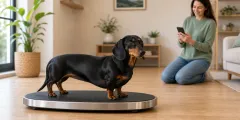




The first year of a puppy’s life is the period of greatest growth — and greatest vulnerability. Weighing your puppy from the start is one of the simplest and most valuable things you can do to ensure their development is on track.
From what age should you weigh a puppy?
The short answer: from day one, if you have access to the litter. Responsible breeders weigh puppies right after birth and every 24 hours during the first week, because weight loss in the early days can signal serious nursing or health problems.
If you adopt a puppy from a litter (usually from 8 weeks), start weighing on the day they arrive home and continue doing so regularly.
How often should you weigh a puppy?
The optimal frequency varies by age:
| Age | Recommended frequency |
|---|---|
| 0–4 weeks (breeders only) | Daily |
| 4–8 weeks | Every 3–4 days |
| 8–16 weeks | Weekly |
| 4–6 months | Every 2 weeks |
| 6–12 months | Monthly |
| Giant breeds (up to 24 months) | Monthly until growth is complete |
A healthy puppy should never lose weight, except for the slight physiological loss in the first 24–48 hours after birth (maximum 10 % of birth weight, recovered by day 7).
What weight gain is normal?
Expected weight gain varies enormously by breed size:
Small breeds (< 10 kg adult)
- Week 1–2: Double their birth weight.
- Month 1: Approximately four times birth weight.
- At 8–10 months: Close to final adult weight.
Medium breeds (10–25 kg adult)
- Gain around 300–600 g per week during the first months.
- Reach 50 % of adult weight by around 4 months.
- Adult weight at 12–15 months.
Large and giant breeds (> 25 kg adult)
- Can gain 0.5–1.8 kg per week during their fastest growth phase, depending on final size.
- 50 % of adult weight is reached around 5–6 months.
- Growth completes between 18 and 24 months.
Don’t try to speed up growth in large breeds with high-calorie diets. Overweight in large-breed puppies increases the risk of hip dysplasia and other orthopaedic problems.
How much weight should a puppy gain per week?
A practical veterinary rule of thumb: during the first months, a puppy gains roughly 2–4 g per day for every kilogram of expected adult weight (about 1–2 g per pound). Per week, that works out at 15–30 g per kilogram of expected adult weight.
| Expected adult weight | Normal gain per week (guide) |
|---|---|
| 5 kg (toy/small) | ~75–150 g |
| 10 kg (small) | ~150–300 g |
| 20 kg (medium) | ~300–600 g |
| 30 kg (large) | ~450–900 g |
| 40 kg or more (giant) | ~600–1,200 g |
Two caveats make this a guide, not a rule:
- Growth is not linear. Most puppies gain fastest between roughly 2 and 5 months, then slow down as they approach adult size — so a “low” week in an 8-month-old puppy is usually normal.
- Breeds and individuals vary. Evidence-based growth curves, like the WALTHAM puppy growth charts, and your vet’s assessment matter more than any single number.
What has clinical value is the trend: steady gains week after week, with no losses and no long plateaus.
Warning signs during growth
Contact your vet if you notice:
- Weight loss with no obvious cause (illness, parasites, digestive problems).
- Stagnation for more than 5 consecutive days.
- Excessive gain clearly exceeding the breed’s reference curves.
- Marked difference between the puppy and its litter siblings of more than 25 %.
How to weigh a puppy at home
For weights up to 5 kg, a precision kitchen scale (with 1–5 g resolution) is ideal. For larger puppies, a bathroom scale works well: weigh yourself, then hold the puppy and subtract the difference.
Practical tips:
- Always weigh at the same time of day and under the same conditions (before feeding, for example).
- Place a non-slip cloth on the scale so the puppy is comfortable and doesn’t slip.
- Write the result down immediately — memory is less reliable than it seems.
Why recording matters as much as weighing
A single weight tells you nothing. The trend over time is what has clinical value. A puppy weighing 6 kg at 3 months may be perfectly fine or cause for concern: it depends on the breed and whether those 6 kg represent proper growth or stagnation.
That’s why it’s essential to note every weigh-in with its date and review it regularly.
Track your puppy’s history with Dogtorcito
Dogtorcito lets you log your puppy’s weight from day one, build a history with an evolution chart, and spot any deviation visually before it becomes a problem.
When you visit the vet, you’ll have all the data at hand so the professional can assess growth in real context — not just from the day’s single measurement.
Recommended scale
If you’re looking for a scale for this stage, this one matches what the guide explains:
Transparency note: the links below are affiliate links. Buying through them helps keep this project going; the price is the same for you.

Gram-level precision for newborn puppies, toy dogs and kittens. The tray keeps them from wobbling during weigh-ins.

FAQ
When should I start weighing my puppy?
Start from day one if you have access to the litter. Breeders weigh newborns right after birth and every 24 hours during the first week to catch nursing or health problems early. If you adopt a puppy, begin weighing on the day they arrive home and continue regularly.
How often should I weigh a puppy?
Daily from birth to 4 weeks (breeders), every 3–4 days from 4–8 weeks, weekly from 8–16 weeks, every two weeks from 4–6 months, and monthly from 6 months to 1 year. Giant breeds should be weighed monthly until growth is complete at around 18–24 months.
What is normal weight gain for a puppy per week?
A practical guide is 15–30 g per week for every kilogram of expected adult weight: around 150–300 g per week for a future 10 kg dog, or 600–1,200 g for a future 40 kg dog. Growth is fastest between roughly 2 and 5 months. The steady trend matters more than the exact figure — no losses and no long plateaus.
How do I weigh a puppy at home?
For puppies under 5 kg, a precision kitchen scale with 1–5 g resolution works well. For larger puppies, use a bathroom scale: weigh yourself, then hold the puppy and subtract the difference. Always weigh at the same time of day, before meals, and note the result immediately.
When should I be concerned about my puppy’s weight?
Contact your vet if your puppy loses weight without a clear reason, shows no gain for more than five consecutive days, gains excessively beyond breed references, or weighs 25 % or more less than its litter siblings.
Start early, weigh regularly, record every reading: these three simple habits are the foundation of tracking any puppy’s growth.
References
-
WALTHAM Petcare Science Institute. Puppy Growth Charts.
https://www.waltham.com/resources/puppy-growth-charts -
Revival Animal Health. Vet Minute: Puppy Weight Gain.
https://www.revivalanimal.com/learning-center/vet-minute-puppy-weight-gain
Related articles:
Check your pet's weight
Use Dogtorcito's free calculator to compare current weight with breed and sex ranges, then keep tracking the trend.
Open weight calculator