


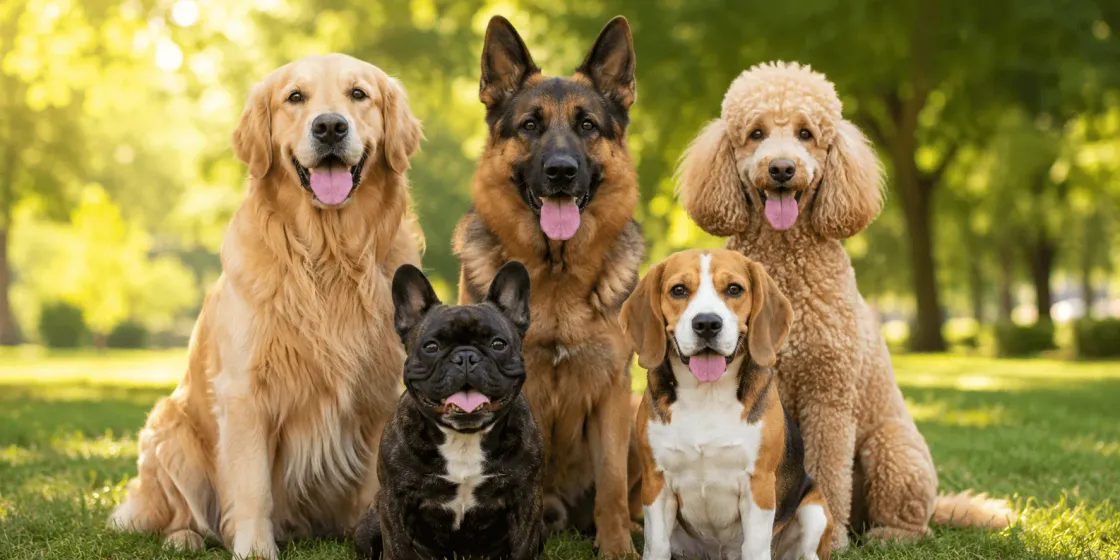
The most popular dog breed is no longer the Labrador: the American Kennel Club’s 2025 ranking puts the French Bulldog at number one for the fourth year running, with the Labrador second and the Golden Retriever third. This guide covers the most popular breeds one by one — adult weight, temperament, what to watch for and how much exercise each one needs — so you can decide which fits your life. If you only need weight figures, see the general weight-by-breed table.
The most popular breeds at a glance
The AKC ranking measures registrations in the United States. It is the most widely cited popularity thermometer, but rankings differ by country: national kennel clubs record very different top tens.
| Breed | Adult weight (male / female) | Exercise | Typical lifespan |
|---|---|---|---|
| French Bulldog | 9–14 / 8–13 kg (20–31 / 18–29 lb) | Low, never in the heat | 9.8 years (median, 2024 UK cohort) |
| Labrador Retriever | 29.5–36.3 / 24.9–31.8 kg (65–80 / 55–70 lb) | High | ~12 years |
| Golden Retriever | 29.5–34 / 24.9–29.5 kg (65–75 / 55–65 lb) | High | ~12 years |
| German Shepherd | 30–40 / 22–32 kg (66–88 / 49–71 lb) | High, physical and mental | ~10 years |
| Dachshund | Standard 7–9 kg (16–20 lb) · miniature 4–5.5 kg (9–12 lb) | Medium, no jumping | ~13 years |
| Poodle | Toy 1.8–2.7 · miniature 4.5–7 · standard 27–32 / 18–23 kg | Medium-high | 10–18 years |
| Beagle | 10–14 / 9–11 kg (22–31 / 20–24 lb) | High, and scent-led | 12–13 years |
| Yorkshire Terrier | 1.8–3.2 kg (4–7 lb) | Low-medium | ~14 years |
Important: these weights are guideline ranges from the breed standard. Your vet should always adapt the target weight to your dog’s build, age, health and activity level.
French Bulldog
Small, bat-eared and extremely attached to their family, they adapt well to a flat with no garden. They are the urban breed of the moment — and the one that needs the most caveats before you commit.
- Adult weight: 9–14 kg (20–31 lb) in males and 8–13 kg (18–29 lb) in females — French Bulldog weight guide.
- Temperament: playful, curious, very sociable; copes badly with being left alone.
- Health: a brachycephalic breed (short, flat muzzle) with frequent obstructive airway syndrome (BOAS), sometimes requiring corrective surgery. Also skin-fold dermatitis and poor heat tolerance: they are among the dogs most at risk of heatstroke.
- Exercise: short, calm walks, avoiding the middle of the day in summer.
- Lifespan: a 2024 UK study of 584,734 dogs estimated a median lifespan of 9.8 years for French Bulldogs. This is a population estimate, not an individual prediction: actual lifespan depends on each dog’s health and care.
Labrador Retriever
Number one in the AKC ranking for 31 years and still the reference family dog: friendly, playful and highly sociable, a good choice with children.
- Adult weight: 29.5–36.3 kg (65–80 lb) in males and 24.9–31.8 kg (55–70 lb) in females — Labrador weight guide.
- Temperament: affectionate, easy to train, tireless.
- Health: hip and elbow dysplasia, joint problems and an increased tendency to gain excess weight; appetite and risk vary between individuals.
- Exercise: at least an hour of intense activity daily.
- Lifespan: around 12 years. For an individual dog, BCS 4–5/9, muscle mass and veterinary assessment are more useful than targeting the lower half of the weight range.
Golden Retriever
Similar to the Labrador in size and character, distinguished by a golden coat and exceptional patience. An excellent companion, therapy and assistance dog.
- Adult weight: 29.5–34 kg (65–75 lb) in males and 24.9–29.5 kg (55–65 lb) in females — Golden Retriever weight guide.
- Temperament: gentle, biddable, sociable with people and other animals.
- Health: higher than average predisposition to certain cancers (haemangiosarcoma, lymphoma), hip dysplasia and heart conditions.
- Exercise: high; they need to swim, run or work their nose, not just walk.
- Lifespan: around 12 years. Their coat hides extra kilos remarkably well, so the scale matters more than the eye.
German Shepherd
The working dog par excellence: police, search and rescue, guide work, herding. Intelligent, loyal and highly trainable.
- Adult weight: 30–40 kg (66–88 lb) in males and 22–32 kg (49–71 lb) in females — German Shepherd weight guide.
- Temperament: active and protective. Needs early socialisation and consistent training to avoid anxiety or unwanted behaviour.
- Health: hip and elbow dysplasia, degenerative myelopathy and gastric dilatation-volvulus (GDV).
- Exercise: high, and as mental as it is physical: a bored shepherd invents a job.
- Lifespan: around 10 years. It is one of the breeds with the largest difference between sexes, and growing slowly through the first year protects hips and elbows.
Dachshund
Fifth in the AKC ranking. Three sizes and three coat types share one name — and one common feature: the back.
- Adult weight: standard 7–9 kg (16–20 lb) and miniature 4–5.5 kg (9–12 lb); the kaninchen stays under 4 kg (9 lb) — Dachshund weight guide.
- Temperament: tenacious, scent-driven, with a lot of character for their size.
- Health: intervertebral disc disease. Every extra kilo loads a long spine that is already predisposed.
- Exercise: medium, avoiding jumps and repeated stairs.
- Lifespan: around 13 years, and many reach 15 or 16 if the back holds up.
Poodle
The FCI recognises four sizes, and the breed stands out for intelligence: they are among the fastest learners in canine behaviour studies.
- Adult weight: toy 1.8–2.7 kg (4–6 lb), miniature 4.5–7 kg (10–15 lb) and standard 27–32 kg (60–70 lb) in males, 18–23 kg (40–50 lb) in females — Poodle weight guide.
- Temperament: very intelligent, agile and easy to train.
- Health: hereditary eye conditions, patellar luxation in the small varieties, hip dysplasia in the standard and epilepsy. They have a dedicated guide to common Poodle diseases.
- Exercise: medium-high, and they value mental work as much as physical.
- Lifespan: 10 to 18 years depending on the variety; the smaller sizes tend to live longer.
- On coat and allergies: they shed little, but that does not make them hypoallergenic. The AKC itself is explicit that no dog is 100% hypoallergenic, and a 2012 study found some of the highest levels of the Can f 1 allergen in low-shedding Poodles. If someone at home has allergies, the test is living with a dog, not picking a breed.
Beagle
Compact and hardy, a natural tracker with an extraordinary nose. Very active, curious and quite capable of escaping if a trail looks interesting.
- Adult weight: 10–14 kg (22–31 lb) in males and 9–11 kg (20–24 lb) in females — Beagle weight guide.
- Temperament: cheerful, sociable and stubborn; food motivation helps enormously in training.
- Health: a clear tendency to obesity, back problems, epilepsy and hereditary eye conditions.
- Exercise: high, and better if it involves scent work: a tracking walk tires them more than a running one.
- Lifespan: 12–13 years.
Yorkshire Terrier
One of the most popular small dogs in the world. They weigh little more than a couple of kilos and have an outsized personality.
- Adult weight: 1.8–3.2 kg (4–7 lb) — Yorkshire Terrier weight guide.
- Temperament: active, curious and stubborn. They need obedience work from puppyhood so their size does not become an excuse.
- Health: dental problems from a small mouth, patellar luxation, tracheal collapse and hypoglycaemia in very small puppies.
- Exercise: low-medium; short walks and play at home are enough.
- Lifespan: around 14 years, one of the longest-lived breeds.
How to choose the breed that fits you
Popularity says very little about whether a dog suits you. Before deciding, answer these four questions honestly:
- How much exercise can you really provide on a rainy Tuesday? A Labrador, a Beagle or a German Shepherd without daily outlet end up with behaviour problems.
- How long is the dog left alone? French Bulldogs and Yorkshire Terriers cope badly with long stretches of solitude.
- What veterinary spending can you absorb? Brachycephalic and giant breeds concentrate more interventions across a lifetime.
- Who else lives at home? Children, older adults or allergies change the answer completely.
And one note no table captures: rescue centres have both purebred and mixed-breed dogs of known temperament and settled age, which removes a lot of the uncertainty from the decision.
How Dogtorcito helps with breed-specific care
Every breed on this list comes with its own watch list. Recording the breed in your dog’s profile in Dogtorcito lets you keep those checks where they won’t get lost: the Labrador’s frequent weight checks, the French Bulldog’s respiratory assessments, the Golden’s cardiac check-ups or the Dachshund’s back.
Excess weight is the most modifiable risk factor in almost all of them, so the weight curve is the tool that pays off most: weigh monthly, log the date and spot the trend before it becomes a problem. And if you have several dogs, each one keeps its own history, reminders and vet notes.
Frequently asked questions
What is the most popular dog breed?
According to the American Kennel Club’s 2025 ranking, the French Bulldog, at number one for the fourth consecutive year, followed by the Labrador Retriever and the Golden Retriever. Rankings vary by country, though: each national kennel club publishes its own registration figures and the top three rarely match.
Which dog breed is best for an apartment?
Size matters less than it seems: exercise needs, tendency to bark and tolerance for being alone weigh more. An adult Greyhound lives well in a flat and a Beagle without a daily outlet struggles, even at half the size. Before choosing by square metres, work out the time you will genuinely give the dog every day.
Are there hypoallergenic dog breeds?
No. The American Kennel Club is explicit: no dog is 100% hypoallergenic, because the allergen is in dander and saliva, not just hair. Low-shedding breeds such as the Poodle or the Yorkshire Terrier may cause fewer symptoms in some people, but a 2012 study found high levels of the Can f 1 allergen precisely in Poodles. If someone at home has diagnosed allergies, discuss it with an allergist before deciding.
How long does each dog breed live?
Small dogs generally live longer than large ones: a Yorkshire Terrier averages around 14 years and a German Shepherd around 10. In a UK cohort of 584,734 dogs, the French Bulldog had a median lifespan of 9.8 years; that is a population estimate, not an individual limit.
References
- American Kennel Club — Most Popular Dog Breeds of 2025
- American Kennel Club — Labrador Retriever
- American Kennel Club — Golden Retriever
- American Kennel Club — French Bulldog
- American Kennel Club — German Shepherd Dog
- American Kennel Club — Dachshund
- American Kennel Club — Poodle (Standard)
- American Kennel Club — Beagle
- American Kennel Club — Yorkshire Terrier
- American Kennel Club — Do hypoallergenic dogs exist?
- FCI — Breed standards and nomenclature
- FCI — French Bulldog breed standard (No. 101)
- McMillan et al., Scientific Reports (2024) — Longevity by breed in 584,734 UK dogs