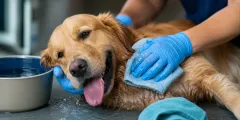



Heatstroke in cats is less common than in dogs, but it can be just as serious. Cats often hide signs until they are very unwell: open-mouth breathing, weakness or collapse are warning signs.
Important: this article is educational and does not replace veterinary diagnosis or treatment. If you suspect heatstroke, start cooling and contact emergency veterinary care as soon as possible.
Quick summary
| What you notice | Why it matters | Next step |
|---|---|---|
| Open-mouth breathing, panting or drooling | In cats, this may suggest heat stress or breathing difficulty. | Move to a cool place and start cooling. |
| Weakness, wobbling, vomiting, diarrhea or collapse | These may suggest serious heatstroke. | Call emergency care while continuing to cool. |
| Persian, senior, overweight, kitten or heart/respiratory disease | Temperature control is less efficient. | Reduce risk and act early. |
Where homes heat up first
For cats in the US and UK, heatstroke often starts in ordinary places: a sunny apartment, a conservatory, a south-facing room, a carrier near a window, or a car that was meant to be “just a quick stop.” Humid cities like Miami, Houston or London during a heatwave can be risky even when the thermometer does not look dramatic; dry heat in places like Arizona, inland California or parts of Spain can make glass, tile and parked cars heat up fast.
If you also live with dogs, the same timing and shade logic from safe summer dog walks helps, but cats often give fewer early signals and may hide before anyone realizes they are in trouble.
Symptoms of heatstroke in cats
Signs may appear after travel in a carrier, a poorly ventilated room, a sunny balcony or patio, a hot car or humid weather.
- Open-mouth breathing, panting or fast breathing.
- Drooling, very red, pale or bluish gums.
- Weakness, restlessness, disorientation or wobbling.
- Vomiting, diarrhea or tremors.
- Seizures, high temperature or collapse.
What to do in the first minutes
Cool first, transport second, without delaying the call to emergency care. Reduce stress: handle the cat calmly and use a ventilated carrier.
- Move the cat to a cool, ventilated or shaded area.
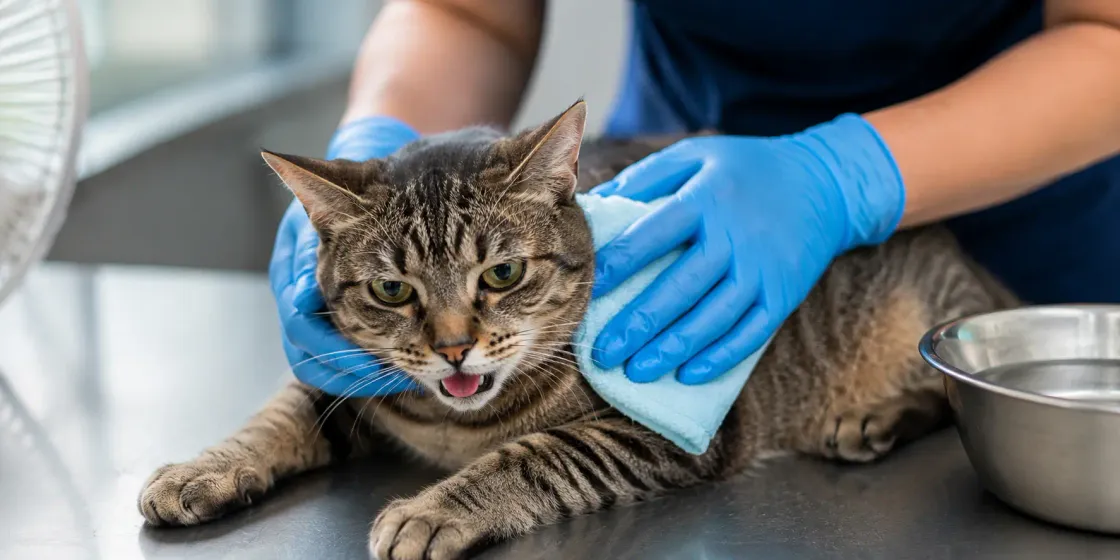
- Start cooling with cool or cold water, not ice baths.
- Carefully wet the neck, chest, abdomen, groin and paws.
- Use a fan, air conditioning or open windows to help evaporation.
- Call emergency veterinary care while cooling.
- Transport the cat when it is safe, keeping airflow during the journey.
What not to do
- Do not leave the cat in a car, carrier in the sun or closed hot room.
- Do not use ice baths or submerge the cat in icy water.
- Do not cover the cat with heavy wet towels that trap heat.
- Do not force the cat to drink if weak, confused or vomiting.
- Do not wait at home because the cat seems better.
- Do not give human medication.
What the veterinarian may check
- Temperature, hydration, breathing and cardiovascular status.
- Blood tests to assess organ injury, electrolytes and coagulation.
- Oxygen, IV fluids and complication control.
- Individual risk to prevent recurrence.
For more context, also see pet emergencies and urinalysis in dogs and cats.
How to prevent heatstroke
- Never leave a cat inside a closed car, even briefly.
- Avoid carriers in direct sun and covers that block ventilation.
- Keep fresh water, shade and ventilated areas at home.
- Watch balconies, patios, attics and rooms without airflow on hot days.
- Reduce stress and travel during the hottest hours.
- Be extra careful with brachycephalic, older, overweight cats, kittens or cats with heart/respiratory disease.
What to record at home
- Time, temperature, humidity and where the cat was.
- Time in car, carrier, patio, direct sun or hot room.
- Signs and when cooling started.
- Cooling measures and changes during transport.
- Reports, medication and prevention advice.
How Dogtorcito helps
In Dogtorcito you can record the time, weather, where it happened, time in a carrier or sun, symptoms, cooling measures, changes during transport, reports, medication and prevention advice so the event does not become scattered across photos and messages.
FAQ
Is panting normal in a hot cat?
Do not treat it as normal. In cats, open-mouth breathing can indicate stress, excessive heat or breathing difficulty and needs quick attention.
Cool water or ice water?
Use cool or cold water and airflow. Avoid ice baths or icy-water immersion unless directly instructed by a veterinarian.
If better, can I stay home?
Not ideally. Internal damage may appear later, so contact emergency veterinary care.